
Use of Carbon Dioxide in Decaffeination Process
Question
Decaffeinated coffee produced using carbon dioxide is often considered to have the best taste. CO2, at 90°C and 250 bar, is fed into an extraction unit where it contacts the green coffee beans, removing most of the caffeine. CO2 at these conditions is an excellent solvent for caffeine and selectively absorbs only caffeine from the coffee beans. The CO2, containing 2.5 weight percent caffeine, is then sent to a caffeine removal unit operation, where its temperature is reduced to 30°C and the caffeine precipitates out of solution and is filtered out. The CO2 is then heated, and recycled back to the extraction unit. A schematic of the process is shown in figure below. Please note that the pressure is approximately constant throughout the process.
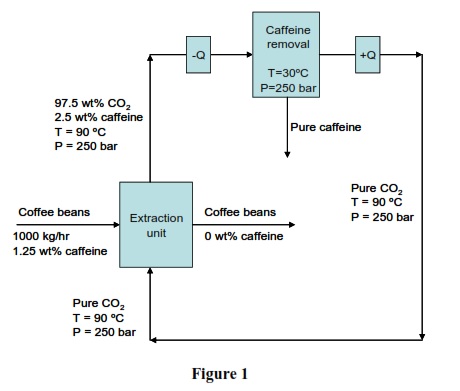
a) Draw and label a pressure versus temperature phase diagram for carbon dioxide. Include on the diagram the operating points of both the extraction unit and caffeine removal unit.
b) Why is CO2 at 90°C a good solvent for caffeine but at 30°C is a poor solvent.
c) Determine the flow rate of CO2 (in m3/min) entering the extractor.
Summary
The question belongs to Chemical Engineering and it is about the process of applying CO2 for caffeine extraction from green coffee beans. The solution discusses some variations in the process.
Note: The solution is in handwritten format.