
State Hypothesis And Calculate Chi-Square Test
Question
A psychologist is studying the effects of certain stressors on overall job satisfaction. One stressor is job insecurity, in particular, a person’s belief about the chances of losing his or her job. Using the General Social Survey (GSS) data, the psychologist develops the following table and side-by-side bar chart. The total number of observations n = 765.
|
Job Satisfaction |
||||
|
Likelihood of Job Loss |
Dissatisfied |
Mod. Sat. |
Very Sat. |
Grand Total |
|
Not Likely |
62 |
265 |
348 |
675 |
|
Fairly Likely |
16 |
17 |
14 |
47 |
|
Very Likely |
12 |
15 |
16 |
43 |
|
Grand Total |
90 |
297 |
378 |
765 |
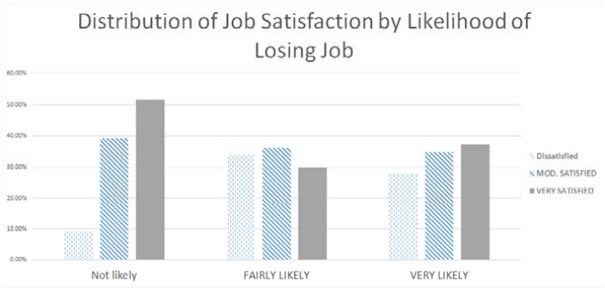
The researcher will use the chi-squared test of independence to examine the relationship. The computer output from the test of independence is given below.
Pearson's Chi-squared test data: .Table
X-squared * 39.0459, df = 4, p-value = 6.816e-08
> .TestSexpected # Expected Counts
Diss Diss. Mod Sat. Very Sat.
Not Likely 79.411765 262.05882 333.52941
Fairly Likely 5.529412 18.24706 23.22353
Very Likely 5.058824 16.69412 21.24706
a). Does there appear to be a relationship just from examining the chart? If so, state what the apparent relationship is. Note: Be specific.
b). State the hypotheses.
c). The expected counts are shown in the output above. Show how the expected count of 79.412 in the upper left of the “Expected Counts” table was calculated. Hint: you will need to use the first table above.
d). Calculate the first (and only the first) term involved in the computation of the chi squared test statistic, assuming the “first term” involves the expected count of 79.412.
e). State the conclusion of the test in the context of the problem, using either the pvalue or rejection region approach, at the 0.05 level.
f). Compute Cramer’s coefficient . Relate this value to your conclusion in (e) and your answer to (a).
Summary
The question belongs to Statistics and it discusses about stating hypothesis and calculating chi-square test for data about job satisfaction and employees who are likely to leave the organization.
Total Word Count 139