
Questions on Refrigeration Unit
Question
Consider the T-S diagram of a refrigerator unit. The working flid is R-22. The refrigerator operates between a low pressure of 0.60 bar absolute (measured in the evaporator) and high pressure of 18.0 bar absolute (measured in the condenser). Assume negligible pressure loss in either condenser (path 1 -> 2) or the evaporator (path 3-> 4). A throttle controls the pressure change between states 2 and 3. A perfectly insulated compressor provides the work for the cycle (Path 4->1). The quality of state 2 is 0.00 and the quality of state 4 is 1.00.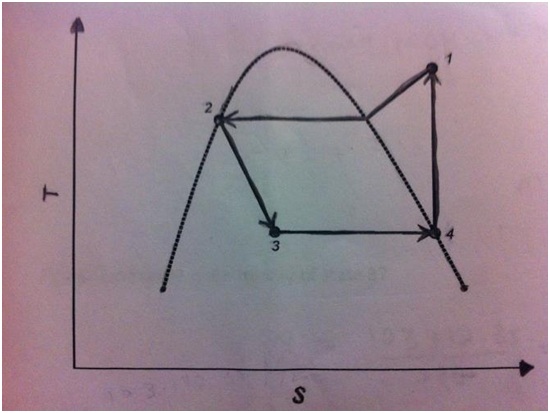
1) If the compressor is 100 % efficient, what is the temperature of state 1?
2) If the efficiency of the compressor was less than 100 %, the enthalpy at state 1 would be
a. Smaller
b. The same
c. Larger
than for a 100 % efficient compressor? Explain
3) What is the quality of state 3?
4) While the cycle is internally reversible, is the cycle plus surroundings completely reversible? Briefly explain.
5) Could you operate this refrigeration cycle if the outside temperature is 118°F? Explain.
6) On a particularly cool day, R-22 emerges from the condenser (state 2) at 36 °C (the pressure remains at 18 bar). What is the enthalpy of this sub-cooled liquid? (Give answer in terms of kJ/kg).
7) Cooling water at 25° C is used to facilitate heat exchange in the condenser (path 1->2). If the temperature of the cooling water can rise no more than 5° C, what is the minimum flow rate
(kg/min) of water that is necessary to completely condense the R-22? Assume that the temperature of R-22 at state 1 is 130° C and the pressure is 18 bar. Take state 2 to be a saturated liquid with a quality of 0.0 and a pressure of 18 bar. The flow rate of R-22 is 1.5 kg/min. For cooling water, you can estimate the change in the enthalpy as dh =CpdT, where Cp is 4.2 kJ/kg*K.
Summary
The question belongs to Chemical Engineering and it is about refrigeration unit. The unit operates at low pressure of 0.60 bar and high pressure of 18 bar. The questions range from the efficiency of the refrigeration unit, the enthalpy depending upon the efficiency, the quality of state, operating temperature of the unit at 118 F, etc. These questions have been answered in the solution in detail.
Note: The solution is in handwritten format