
Producing Propylene glycol Through Hydrolysis of Propylene Oxide
Question
Propylene glycol is produced by the hydrolysis of propylene oxide, typically using inert methanol (M) as solvent: Propylene oxide (A) + Water (B) → Propylene glycol (C)
The rate constant for this reaction, k, follows an Arrhenius model:
k = βe-E/RT
where β = 16.96 x 10¹² hr-1 and E = 75.36 kJ/mol. The reaction rate has been found to be
independent of water and first order in propylene oxide.
This reaction takes place in an adiabatic CSTR, as seen in the figure:
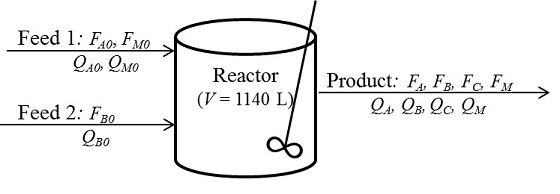
where F is molar flow rate and Q is volumetric flow rate. QA0 = QM0 = 1320L/hr, FA0 = 19,523 mol/hr, FM0 = 32,600 mol/hr, QB0 = 6600.7L/hr, and FB0 = 364,142 mol/hr. Both feed streams are initially at 14.4°C. However, upon mixing, their temperature immediately increases to 23.9°C. Stirring has negligible effect on the temperature in the reactor.
You are to determine the operating temperature of the reactor, T, and the conversion, X, which is defined X = 1-FA/FA0. Note that the reactor is restricted to operating below 53°C because at higher temperature, propylene oxide will vaporize and result in a low yield.
(a) Use a balance on propylene oxide and then substitute to find an expression for the volume of the reactor in terms of the rate constant, net volumetric flow rate, and conversion.
(b) Using your result from (a), find an expression for conversion as a function of temperature and residence time θ.
(c) Perform an energy balance on the reactor to find the conversion in terms of molar flow rates, temperature, heat capacities, and known enthalpy values.
(d) You now have two expressions for conversion as a function of temperature. Graph these two expressions to find the steady-state X and T values for the system. Attach your graph, and discuss the significance of your results. If the calculated steady-state temperature exceeds the maximum acceptable temperature, what design change is required to use this reactor?
Relevant thermodynamic data:
Propylene oxide: CP = 146.54J/mol/°C, H(14.4 °C) = -154.9 kJ/mol
Water: CP = 75.39J/mol/°C, H(14.4 °C) = -286.1 kJ/mol
Propylene glycol: CP = 192.60 J/mol/°C, H(14.4 °C) = -525.7 kJ/mol
Methanol: CP = 81.64 J/mol/°C where H values are with respect to the same reference state.
Summary
The question belongs to Chemical Engineering and the question is about production of propylene glycol by hydrolysis of propylene oxide. The questions are about finding the volume of expression in the reactor in rate of constant, flow rate, etc. and perform energy balance for molar flow rates, temperature, etc.
Note: The answers are in handwritten format