
Hydrogen Production with Catalytic Reaction of Carbon Monoxide and Steam
Question
One process for the production of hydrogen is the catalytic reaction of carbon monoxide and steam. The chemical reaction is given by:
CO + H2O → H2 + CO2
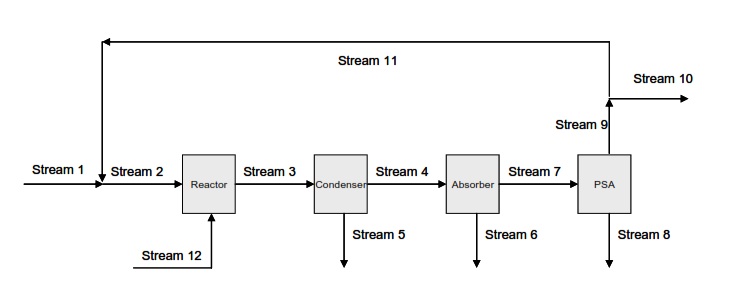
A block flow diagram for the process is shown in Figure. Pure CO is fed to the process in Stream 1 where it is blended with a recycle stream (Stream 11) and fed into a reactor. Stream 12, comprised of pure steam, is fed to the reactor in 55% excess. The products and unreactants leave the reactor in Stream 3 and enter a condenser where all of the unreacted water is removed in Stream 5 (Stream 5 is pure water). The products then enter a CO2 absorber where 98% of the CO2 generated in the reactor is removed and exits in Stream 6 (Stream 6 is pure CO2). The products are then sent to a pressure swing absorber (PSA) where all of the H is removed. Pure hydrogen exits the process in Stream 8. The remaining products leave the PSA in Stream 9, where a small fraction is purged through Stream 10, and subsequently recycled in Stream 11. The single pass conversion of the reactor is 16% while the overall conversion is 90.% (both in terms of CO). It is desired to produce 3.5 kg/sec of hydrogen.
- Why is the recycle stream included in the design?
- What is the purpose of the purge stream? In other words, why would this design not work without the purge stream?
- List two reasons (with supporting explanation) why the single pass conversion might be so low.
- Determine the flow rate and composition of the feed streams (Streams 1 and 12).
- Determine the flow rate and composition of the purge stream (Stream 10).
- What is the flow rate of water (in kg/sec) from the condenser (Stream 5)?
- Suggest a method to increase the conversion of the process. Please provide a brief discussion (2-3 sentences) defending your suggestion.
Summary
The question belongs to Chemical Engineering and it is about hydrogen production with catalytic reaction of carbon monoxide and steam. Various questions about this reaction and the process have been given. The solution has it answered in full detail.
Total Word Count 390