
Design of Multistage Fixed Bed Catalytic Reactor
Question
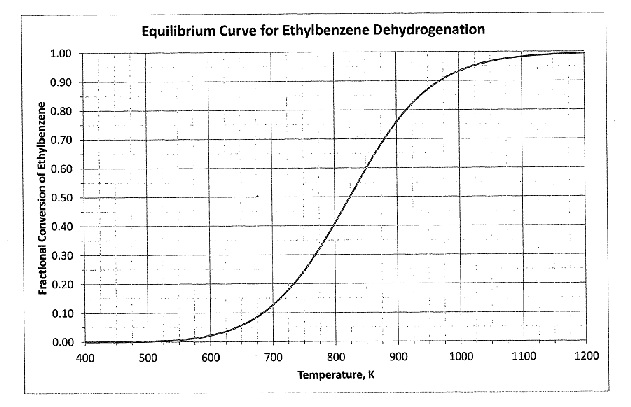
A multistage fixed bed catalytic reactor was to be designed for the dehydrogenation of ethylbenzene (C8H10 = A) into styrene (C8H8 = S), using excess steam to control the reaction temperature. The goal is to reach 90 percent conversion of ethylbenzene, using a multi-stage system if necessary. A new catalyst has been developed, which allows operation at temperatures as high as 1100K, compared to the previous catalyst which would undergo sintering at 1000K. Assuming that the pseudohomogeneous one-dimensional plug flow model is valid, and that each stage operates isobarically:
a. What is the minimum amount of (new) catalyst required for this process? If you integrate numerically, use a step size of 0.3.
b. If the reactor operates adiabatically, how many stages would be required in order to achieve the 90% conversion target with the new catalyst? Assume that the outlet temperature from each stage is 25°C from equilibrium temperature.
c. How much less catalyst is required with the new catalyst versus the old catalyst? A reasonable estimate is sufficient (but state your assumptions)
Data: FAO = 80mol/s; FH2O = 1200mol/s; PO = 2.5 bar; ∆HRA = 126 kJ/mol; Cp = 2.4 Jg-lK-1; (-rA) = kA(PA- PSPH2/Kp); kA = 3460e-10980/Tmol(kg cat)-1S-lbar-1; Kp = 8.2 X 10⁶e-15,200/T bar.
Summary
The question belongs to Chemical Engineering and the question is about multistage fixed bed catalytic reactor is to be designed for dehydrogenation of ethylbenzene into styrene. A new catalyst is being deployed and 90% conversion is being expected. The question has been answered clearly in the solution in much detail.
Note: The answers are in handwritten format