
Cooling Down of Ethanol Steam in a Heat Exchanger
Question
In the heat exchanger shown below, the “tube fluid” (ethanol) enters and leaves at the same end of the heat exchanger, whereas the “shell fluid” (water) always moves in the same direction. Thus, there are both parallel flow and counter-current flow in the same apparatus. This flow is one of the simplest examples of “mixed flow,” often used in practice to reduce heat exchanger length.
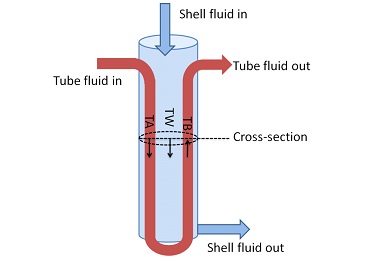
Make the following assumptions:
(i) Steady-state operation.
(ii) The heat capacities of both water and ethanol are constants. CP,water = 4.18J/g-K. CP,EtOH = 2.46J/g-K.
(iii) The shell-fluid temperature is constant over any cross-section perpendicular to the flow direction.
(a) An experiment is performed in the heat exchanger using chilled water (shell fluid) to cool a stream of ethanol (tube fluid). The chilled water enters at 10°C at a flow rate of 20kg/min, and the outlet is measured to be 25°C. An ethanol stream is cooled from 70°C to 30°C. What is the flow rate of ethanol in kg/min?
(b) During another experiment with 20kg/min chilled water (shell fluid) and 10kg/min ethanol (tube fluid), the temperature inside the tubes at points A and B is measured to be TA = 60°C, TB = 40°C and the temperature at the water (shell fluid) outlet is measured as T = 20°C. What is the temperature of the water inside the shell at the same cross-section point at which points A and B were measured? Hint: mentally cut the heat exchanger at the cross section and perform an energy balance.
Summary
The question belongs to Chemical Engineering and the question is about heat exchanger where the flow rate of ethanol is to be estimated with cooling down of ethanol steam and the temperature of flowing chilled water has to be estimated when the heat exchange is taking place. The calculations have been given in the solution in detail.
Note: The answers are in handwritten format