
Calculate the Energy Requirements for Freezing, Unfreezing and Refreezing of a Chocolate Bar
Question
Heat equation and freezing of a candy bar. Producing a chocolate candy bar that has the desired texture, consistency, and mechanical properties for satisfaction requires a precise cooling schedule. (Have you ever had a candy bar that melted and refroze and didn't like it nearly as much as the original product?') Assume
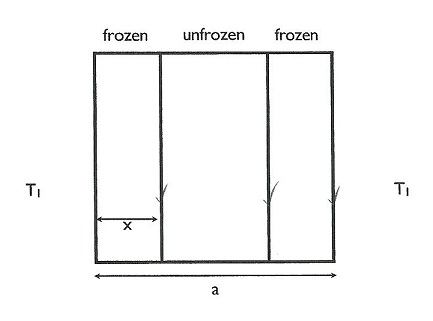
that initially, all the bar is at the freezing temperature (Tf), but has not yet frozen. For freezing to take place energy needs to be removed from the system. The unfrozen bar is placed into a cooler environment at temperature T1 and heat energy flows out of the bar and additional material becomes frozen. The thermal conductivity (k) of the frozen part is constant.
(a) Draw three new pictures of the bar as it freezes. For the first one, draw the temperature distribution at time t = 0. Then draw an intermediate time point, and lastly show the steady-state temperature distribution. In all the three pictures draw the boundary between frozen and unfrozen parts of the bar.
(b) Draw a "quasi steady-state" temperature distribution on the figure provided above. The temperature of a substance does not drop below the freezing point before freezing. i.e, water freezes into ice at 0 degrees Celsius. Have you ever seen a, glass of liquid water with a, temperature of -5 degrees Celsius? Use Tf on the boundary between the frozen and unfrozen material. Use 1s at the solid/environment interface and assume Newton's law of cooling as in the homework.
(c) Write down an expression for the heat flux q leaving on the left side of the bar as a function of the thermal conductivity k, x, Ts and Tf Also determine (Tf - T1) assuming h is the heat transfer coefficient between T1 and Ts. Rearrange the heat transfer equation to have q as a function of x, k, h, and Tf, T1. Here and for the remainder, only consider z Σ (0, a/2).
(d) The total mass of chocolate bar that is frozen in time interval dt is A. dx. p where A is the cross-sectional area d:x: is the thickness of the slice that has frozen and p is the mass density of the unfrozen material. The heat energy required to freeze that amount of chocolate is equal to the total mass frozen times the latent heat of freezing λ. Specifically, that means qAdt = Apλdx. Use this relationship to derive the units of A.
(e) Substitute in the relationship for q from (c:) into qAdt = Apλdx to derive the differential equation for dx/dt. Rearrange the equation and integrate from t = 0 to t = tf, the freezing time and from x = 0 to x = a/2. This is an estimate of the freezing time for a chocolate bar.
Summary
The question belongs to Chemical Engineering and it is about calculation of freezing, unfreezing and refreezing energy taken by a chocolate bar. The calculations along with diagrams have been given in the solution.
Total Word Count 245