
Calculate Heat Transfer in a Furnace Powered by Propane
Question
In an industrial process, propane is combusted in a furnace at 1000°C. An inlet stream of propane enters at 100 mol/s and 25°C. An air stream containing 20% excess oxygen enters the reactor at 300°C. The propane reacts completely with oxygen to form water and carbon dioxide
by the following reaction:
C3H8(g) + 5O2(g) → 3CO2(g) + 4H2O (l) ∆Hr0 = -2220 kJ/mol
Assuming no shaft work, calculate the heating requirement for the furnace using two different methods: (i) the heat of reaction method and (ii) the heat of formation method. Is heat transferred to or from the furnace?
Relevant thermodynamic data:
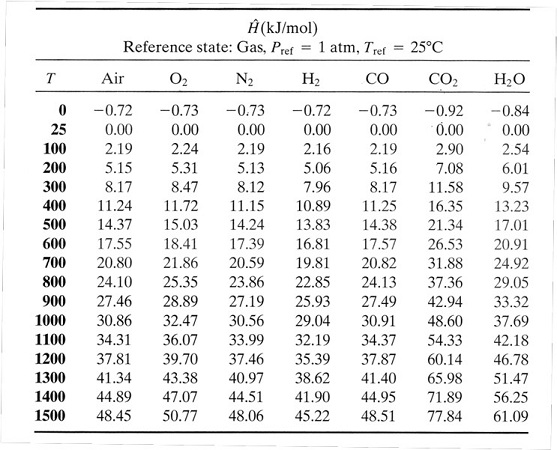
Water (gas): ∆Hf = -241.83kJ/mol, ∆Hv = 40.656kJ/mol
Water (liquid): ∆Hf = -285.84kJ/mol, CP = 75.4J/mol/K
Propane (gas): ∆Hf = -103.8kJ/mol
Carbon dioxide (gas): ∆Hf = -393.5kJ/mol
Summary
The question belongs to Chemical Engineering and the question is about heat transfer in a furnace where propane is used as the fuel with air being pumped with 25% extra oxygen. The question is to find the heat reaction method, heat of formation method and whether heat is transferred to or from the furnace.
Note: The answers are in handwritten format