
Analyze the Catalytic Methanol Production Process
Question
One process for the production of methanol is the catalytic reaction of carbon dioxide and hydrogen. The chemical reaction is given by:
CO2 + 3H2 → CH3OH + H2O
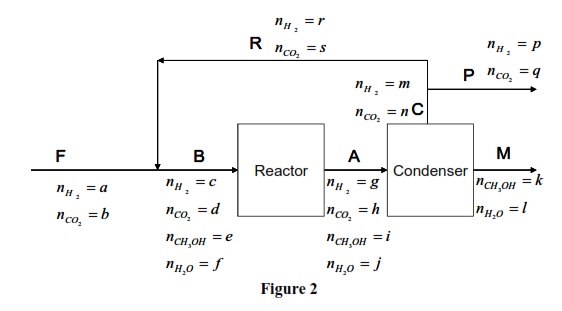
The diagram for the process is shown in Figure 2. It is desired to produce 1.00 × 10mol/hr of methanol. The single pass conversion of the reactor is 10.% while the overall conversion is 80.% (both in terms of hydrogen). Note, carbon dioxide in the fresh feed is in 20.% excess and all of the product (methanol) and byproduct (water) is removed in the condenser.
a) Why is the recycle stream included in the design?
b) What is the purpose of the purge stream? In other words, why would this design not work without the purge stream?
c) Determine the flow rate and composition of the feed stream (F).
d) Determine the flow rate and composition of the purge stream (P).
e) What percentage of the flow leaving the condenser enters the purge stream?
f) Determine the recycle ratio (R/F).
Summary
The question belongs to Chemical Engineering and it is about the hydrogenation process of carbon dioxide for methanol synthesis. Various questions about this process have been answered in the solution in detail.
Note: The solution is in handwritten format